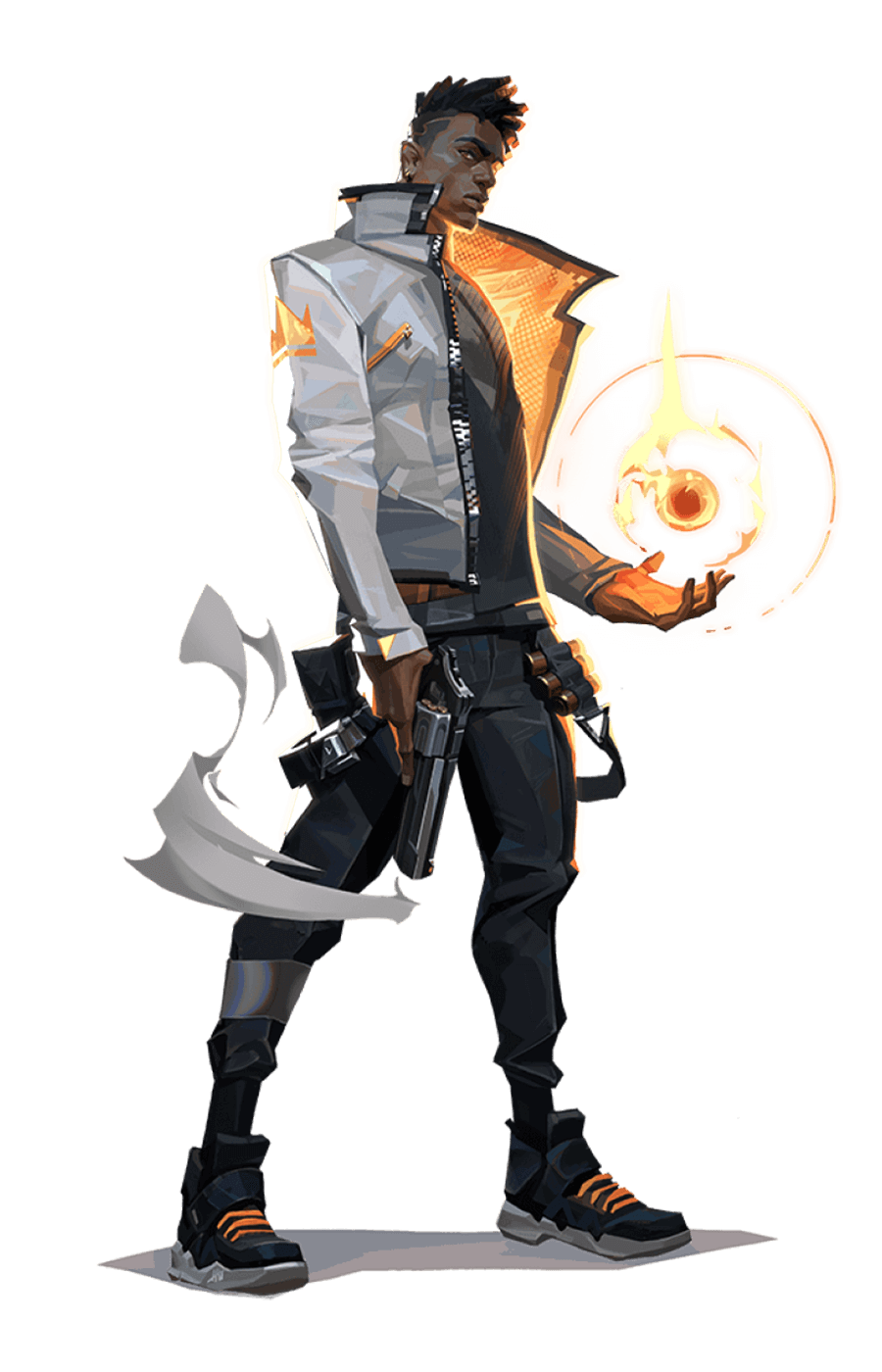
Fire-wielding duelist with self-heal. Learn Hot Hands positioning, Curveball flashes, and Run It Back entry tactics.
Duelist · Fire-wielding duelist with self-heal.
1. Ability Breakdown and Usage
Phoenix is a self-sufficient duelist whose fire-based abilities heal him while damaging enemies. Curveball fires a flash grenade that bends around corners — it can be thrown left or right for different flash trajectories. Hot Hands is a fireball that creates a healing zone on impact, restoring 50 health over 6 seconds while damaging enemies who enter. Blaze creates a wall of fire that blocks vision and heals Phoenix when he walks through it. His ultimate Run It Back creates a marker at the cast location — if he dies during the duration, he respawns at the marker with full health. Unlike other Valorant duelists, Phoenix is entirely self-sufficient with built-in healing and a free-entry ultimate.
2. Best Map Compositions
Phoenix excels on maps with tight corners where his Curveball flash catches enemies off guard. On Split, his curveball can flash B Garage and A Ramen from safety. Bind's teleporter rooms are perfect for Hot Hands healing before engaging. Ascent allows Phoenix to flash A Short and peek with Blaze wall covering his advance. Lotus's rotating doors create unique Curveball trajectories. He struggles on open maps where enemies can dodge his flash from long range. Valorant entry duelist guides show Phoenix is a solid pick for players who want self-sufficiency without relying on team utility for entry.
3. Synergy with Other Agents
Phoenix pairs well with controllers who can cover his entry path while he focuses on fragging. Omen's Paranoia blind combo'd with Phoenix's Curveball creates layered vision denial that enemies cannot play through. Brimstone's Stim Beacon speeds up Phoenix's push while his fire abilities heal through damage. Sage's healing orbs give Phoenix even more sustain for extended site holds. On defense, Phoenix's Run It Back provides free information about enemy positions while Blaze denies site access. Reyna's dismiss and Phoenix's self-heal create an aggressive duo that sustains through multiple engagements without needing support. Phoenix on Valorant Fandom covers creative Curveball flash setups and Blaze wall placements for every competitive map.
4. Pro Tips and Techniques
Mastering Phoenix requires positioning your fire for both damage and healing. Curveball can be thrown left or right — vary your flash direction each round to keep enemies guessing. Hot Hands heals you for 50 health over 6 seconds — use it after taking damage rather than before. Blaze wall heals for 12 health per second while blocking vision — walk through your own wall to heal up before peeking. Run It Back places a visible marker — conceal it behind cover so enemies cannot camp your respawn point. Use Blaze to heal while holding an angle — the fire wall blocks enemy vision while restoring your HP. Liquipedia's Phoenix guide features VCT pro analysis showing optimal flash-and-peek combinations and Run It Back entry strategies.
5. Countering Phoenix
Playing against Phoenix requires tracking his flash cooldowns and denying his healing. Turn away from Curveball to avoid the blind — the flash has a distinct audio cue. Shoot Phoenix through his Blaze wall — bullet tracers reveal his position inside the fire. Cancel Phoenix's Run It Back by camping his marker — he respawns at the exact same location. Kay/O's suppression prevents Phoenix from using any fire abilities including self-heal. Breach's Fault Line can concuss Phoenix through Blaze wall without taking fire damage. His self-heal is limited per round — force multiple engagements to drain his resources. On Valorant Fandom you can find specific counter-strategies including optimal flash-dodge timing and Run It Back marker denial tactics.